


the importance of stance in your golf setup - with every club
Demonstration

STANCEMATE · REPEATABLE SETUP
StanceMate makes stance width and ball position visible, measurable and repeatable for every club in the bag — from driver and irons to wedges, pitching, chipping and putting.
Start from your own body, create a known setup, hit shots and fine-tune it. Once you find the position that gives you the best strike and ball flight, you can return to it instead of rebuilding your stance from memory.
Better setup can simplify low point, angle of attack, contact, rotation and consistency before you add another swing thought.

StanceMate is not about telling every golfer to stand in exactly the same place. It gives you a measured starting point for stance width and ball position, then lets you adjust that starting point from the shots you actually produce.
The useful part is knowing where you stood last time. Once the setup is measurable, a deliberate change is actually a change you can identify and repeat.
Demonstration
Demonstration
Golfers are often told to stand about shoulder-width apart. It sounds simple until you ask where shoulder width begins and ends. Collar bones? The outside of the deltoids? If you are built like Arnold - Schwarzenegger, not Palmer - those are very different measurements.
StanceMate starts lower down, using the golfer's own feet and leg geometry to establish a neutral, balanced baseline that can be reproduced on the ground.
You do not have to agree with our starting width forever. Widen it, narrow it and keep the setting that produces the best repeatable result for you. The point is that you know what changed and can get back to it.
Ball position can become golf's Pandora's box because a small move changes the relationship between the club, the body and the ball. Rather than pretending there is one perfect position for every golfer, StanceMate gives you a club-by-club starting framework you can actually measure.
Set the reference, hit enough shots to judge contact and ball flight, then move the ball deliberately if the result tells you to. The useful part is not agreeing with Stryper forever. It is knowing exactly where you started, how far you moved and which setting worked better.
Ball position can influence low point, angle of attack and strike, but it does not control those outcomes on its own. Your movement still matters.
STANCE-WIDTH BASED ON YOUR BODY
This isn’t a one-size-fits-all product like those cheap mats you see on Temu. It is scientific, but it can be tailored to you. Because it’s fully adjustable, it also means other family members can use it with a quick change.
ADJUSTS FROM JUNIOR TO GIANT
We’ve trialled StanceMate with kids as young as 12 with great results. The minimum stance width is 17cm between ankles and the maximum is a whopping 56cm, so even Bryson should be able to use it.
PERFECT YOUR BALL POSITION
Ball position is critical to every shot with every club, and you need to be accurate. A centimetre at the tee will be metres off-target on the fairway. Knowing what works for you is important and will boost your confidence on course.
CONFORMS TO ARTIFICIAL MAT SIZES
The length of StanceMate in its full form is less than 120cm (4’ or 48”) which is the length of 99% of artificial turf mats sold on the market and used in indoor golf ranges and other golf training facilities.
MOLLYDOOKERS MOST WELCOME
Australian slang for a left-handed person is a “mollydooker”. We’ve built both the SwingMate and the StanceMate completely compliant for our back-handed brethren.
BUILD QUALITY
StanceMate is designed around an anodised aluminium body and laser-etched reference markings, so the measurements remain part of the product while you adjust it for different clubs and golfers.

The rigid adjustable body gives you a physical measurement on the ground rather than a setup position you have to recreate from memory.

The club and ball-position references are etched into the product so you can record a useful setting, change it deliberately and return to it later.
Why the heel area? Because foot flare changes the position of the toes without necessarily changing the stance width you intended to keep.
This is not the only possible measuring convention, but it is ours - and we stand by it, pun fully intended. A heel-based ground reference lets you flare a foot more or less without accidentally changing the measurement you are trying to repeat.
If another reference works better for you, use it. Consistency matters more than winning an argument about where a ruler should start.
A 7-iron is a practical place to establish the first baseline. Start from a neutral, balanced standing position, set StanceMate to your own body geometry and use the marked club progression as a starting framework.
Then hit shots. If a slightly wider stance or a slightly different ball position produces a better repeatable result for you, adjust StanceMate and keep that setting. The product is meant to make experimentation measurable, not stop it.
And if you already have a setup system you trust, use StanceMate as an adjustable ruler and mark your own preferred positions. We are happy if the reference helps you repeat what works.
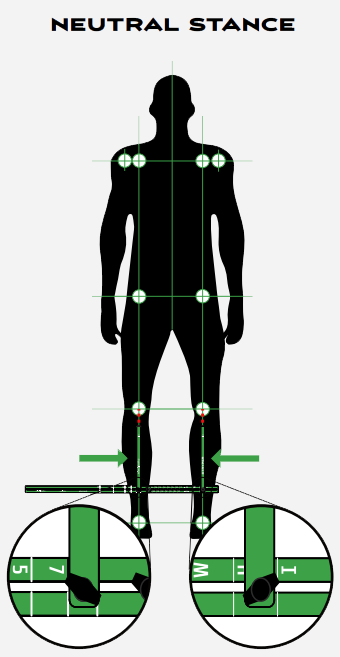
Ball position and stance width change the geometry from which you deliver the club, so they can influence where the swing bottoms out and whether the strike is steeper or shallower.
StanceMate does not mechanically create a low point or angle of attack. For iron shots, a useful goal is normally to strike the ball before the turf; with longer clubs the delivery becomes progressively shallower, and driver is commonly struck on the upswing.
StanceMate's job is to help you reproduce the setup conditions you want to test while your swing determines the actual strike.
StanceMate is a standalone setup trainer. You can use it on its own to make stance width and ball position measurable and repeatable from club to club.
If you also want visible references for swing plane and path, hand/handle delivery space, posture-related movement and body rotation/club-exit sequencing, SwingMate can be added separately or bought with StanceMate in the Stryper Plus bundle.

STRYPER GOLF REVIEWS
Customer, coach and reviewer feedback on Stryper’s swing plane trainer, stance setup aid and complete setup-and-swing practice system.
StanceMate includes setup guidance, and Stryper also provides an in-depth video, a printable guide and a quick-start guide online.
Yes. The current StanceMate guidance includes a separate reference for smaller players and recommends coach input where a more individual setup is needed.
Yes. StanceMate can be used left-handed by turning the product around and extending the smaller arms toward the player.
Yes. StanceMate is a standalone product for stance width and ball-position references. SwingMate is optional if you also want visible references for swing plane/path, hand/handle delivery space and body rotation/club-exit sequencing.
Go deeper on the biomechanics and coaching rationale behind stance width.
See the deeper explanation of how ball position changes the delivery conditions for different clubs.
Use the StanceMate support page for setup guidance, videos, printable instructions and troubleshooting.
Where the ball sits relative to your stance matters. So does the width of the stance supporting the movement around it.
Use StanceMate to train the setup conditions that help produce the low point and angle of attack you want. With irons, that can mean a setup that supports compression and a low point after the ball. With fairway woods, a progressively shallower strike. With driver, a wider stance and forward ball position that supports hitting up on the ball.
Instead of trying to manufacture angle of attack entirely with another swing thought, put the ball and your body in a position that makes the movement easier.
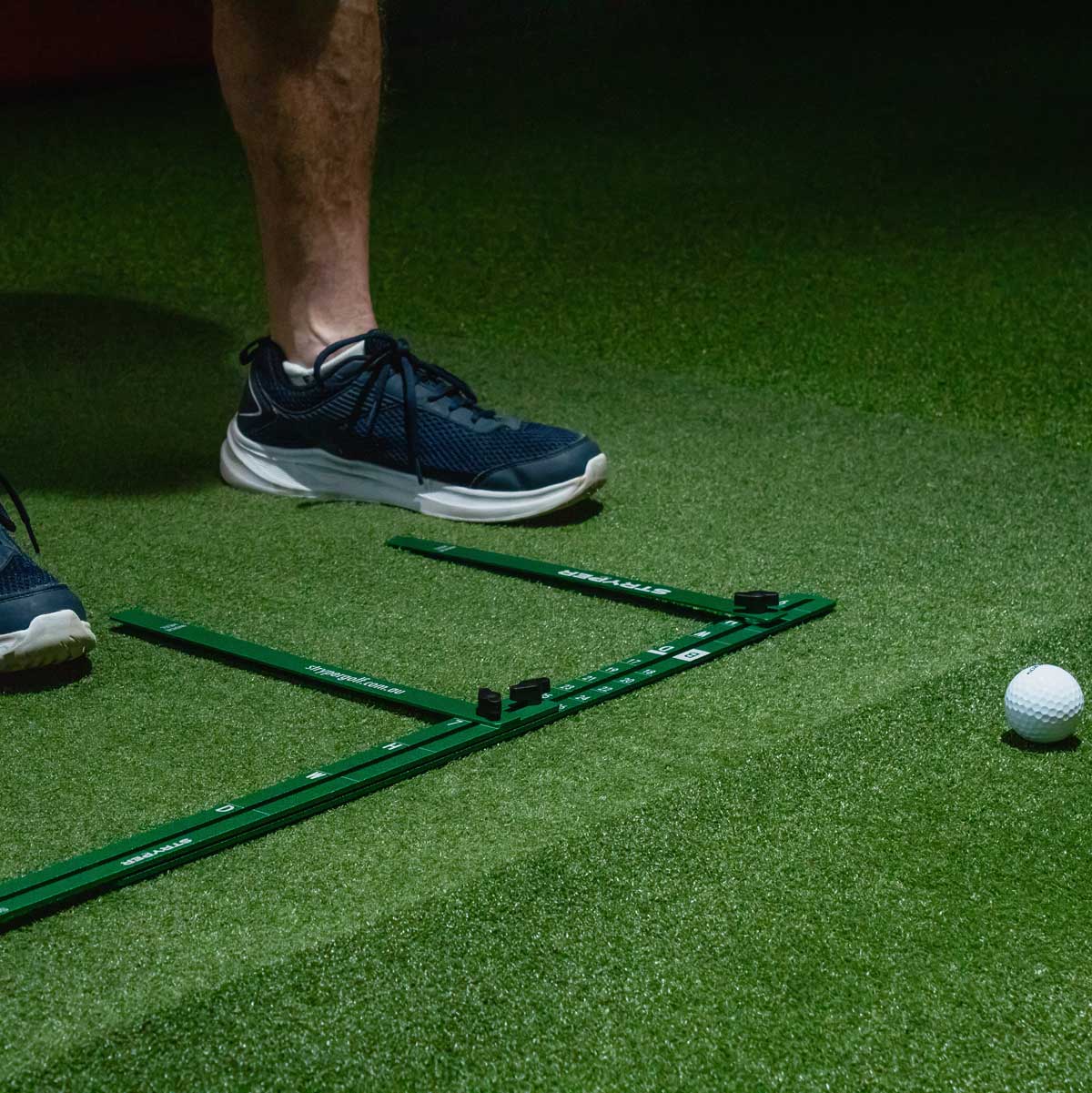
Low-point control becomes much easier to understand when the ball is not moving around inside the stance from shot to shot.
If you keep hitting behind the ball or catching it thin, establish a precise starting position and make controlled adjustments. Now you can see whether the strike improves because the setup changed rather than reacting with a different swing thought every shot.
Distance from the ball, stance width, balance and ball position all affect the geometry you start from. A golfer constantly changing those relationships is asking the club to return to a moving target.
StanceMate gives you a repeatable reference. Once the setup is stable, strike patterns become far easier to understand and improve.
Read more about heel and toe strikes if you want the full contact breakdown, but the important setup concepts live here where you buy the product.
Too wide and many golfers struggle to turn freely. Too narrow and stability and power can disappear.
Find the width that gives you the best combination of rotation, balance and strike for your body. Then remember it — because StanceMate does.
The clubs in your bag change dramatically in length, loft and intended delivery. Your setup should change with them.
Once you understand the progression, personalise it. The 7-iron setting that works beautifully for you does not need to be guessed again next Tuesday. Neither does the driver. Neither does the 54-degree wedge.
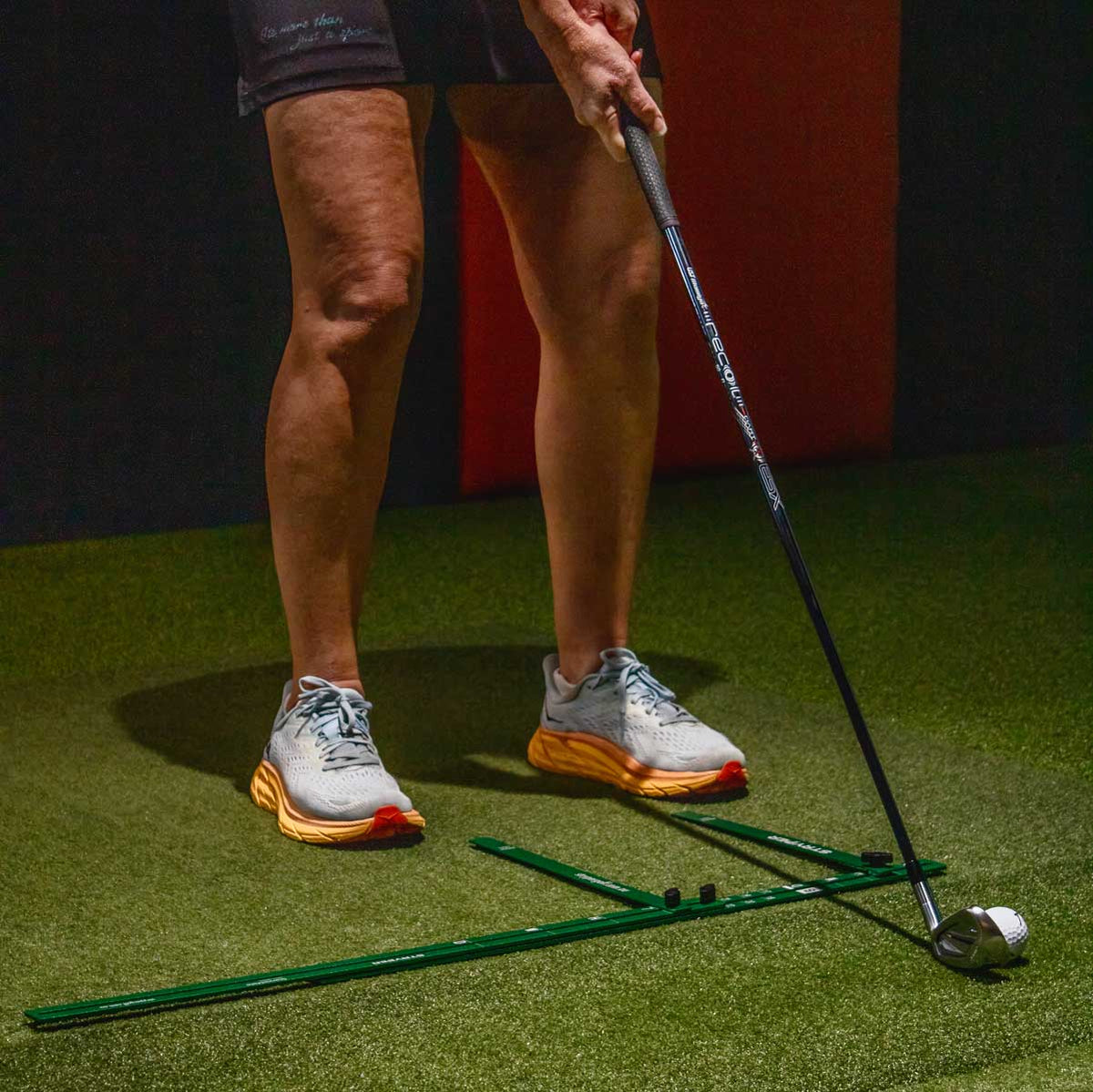
Short-game setup changes are perfect for a measured tool.
Narrow the stance deliberately. Change ball position deliberately. Test different trajectories and strike patterns. Record the setup that works. Instead of rediscovering your favourite pitching or chipping position every practice session, return to it.
StanceMate is equally useful on the green. Repeat your putting stance width. Repeat ball position relative to your feet. Use the centre reference to help with alignment and stroke setup.
Small inconsistencies matter enormously when the target is a four-inch hole rather than a fairway.