
Swing faults and ball flight laws explained
Fix your golf swing: find the fault from your ball flight
Slicing it, hooking it, pulling it or catching it fat? Your ball flight already knows why. Find your miss below, fix the cause, not the symptom.
Diagnose your miss
Match your ball flight, find the cause, fix it
Your ball flight is a report card on what the club did at impact. Find your miss below, read what causes it, then set SwingMate up so the club can only travel the path that fixes it.
It is the same principle a good coach uses when they change your swing inside a single lesson: change the path the club is allowed to take and the ball flight changes with it. One customer on a simulator went from a slice to a draw in about a dozen swings. Keeping it takes repetition, which is why the rods stay exactly where you set them and the same reference is waiting every session.
- What causes a slice, and how do you fix it?
- Why am I hooking my driver? What causes a pull hook?
- What causes a push or a push slice?
- How do I stop coming over the top?
- What is early extension, and how do you stop it?
- Why do I hit it fat, thin, off the heel or off the toe?
Got a two-way miss, a hook one week and a slice the next? That usually means the face-to-path relationship is changing from swing to swing. Fix the path first and the face has something consistent to square up to.
Slice
What causes a slice, and how do you fix it?
Your ball flight: starts left of target (or straight) and curves hard right. Right-handed; flip it if you are a lefty.
What causes it: the clubface is open to the swing path at impact. For most golfers the path is also out-to-in, the club cutting across the ball. Swing harder at a slice and it usually gets worse, because the cut gets bigger.
The fix: give that out-to-in move a boundary. Set SwingMate up with a draw-biased ground path and an angled raised rod that you swing under, so the club has to arrive from the inside. In one simulator session a customer went from a slice to a draw in about a dozen swings, confirmed on the launch monitor with the rods taken away.
Pull hook
Why am I hooking my driver? What causes a pull hook?
Your ball flight: a hook curves hard left. Check where it starts. A hook that starts right of target and turns left is a different problem from a pull hook that starts left and keeps going left.
What causes it: the face is closed to the path at impact. If your hooks start right, the path is usually too far in-to-out: the club gets stuck behind you and the hands flip the face shut to save it. That is the golfer who has been fighting a hook for a year that comes and goes, draw one week, hook the next, out of bounds the week after. If your hooks start left, the path is more likely out-to-in with a shut face, often the same over-the-top move that causes a slice on other days.
The fix: for the hook that starts right, come less from the inside. Reverse SwingMate to a fade-biased gate: a more upright plane reference and a path that stops the club running away behind you. For a pull hook that starts left, use the over-the-top setup below.
Push and push slice
What causes a push or a push slice?
Your ball flight: starts right of target and either flies straight right (a push) or keeps curving right (a push slice).
What causes it: the path is in-to-out and the face is pointing right at impact. Many golfers with a push slice are surprised to learn they are not coming over the top at all. The club is getting stuck too far inside, often because the body sways off the ball or the hands are too high through impact.
The fix: set an upright SwingMate rod to monitor your head position and stop the sway, and a lower rod to keep the hands low through impact and exiting left.
Over the top
How do I stop coming over the top?
Your ball flight: pulls that start left, slices that start left and curve right, or both on the same day.
What causes it: coming over the top means the club moves outward at the start of the downswing and comes down steep and out-to-in. Steep versus shallow is the same idea seen from behind: a steep club approaches above the plane it went back on, a shallow club drops slightly under it and attacks from the inside.
The fix: frame both the plane and the path with SwingMate rods, so the over-the-top move has a physical boundary and the inside approach has a picture you can rehearse. A driver test on SwingMate produced a 0.0° club path on the simulator.
Early extension
What is early extension, and how do you stop it?
Your ball flight: blocks right, flips left, thin and heel strikes, often a mix of all of them.
What causes it: early extension is when the hips and body move towards the ball in the downswing. The hands and handle lose their room at impact, so the club has to be rerouted or flipped to find the ball.
The fix: set a SwingMate impact-space boundary for the hands and handle, plus a knee, thigh or hip checkpoint, so you can see whether you keep your posture and your space through the strike.
Strike
Why do I hit it fat, thin, off the heel or off the toe?
Your ball flight: the ball flight may be fine, but the strike is not: divots behind the ball, thin shots, heel strikes, toe strikes or the occasional shank.
What causes it: very often it starts before the swing does. If the ball position, stance width or distance from the ball changes from shot to shot, the club is returning to a moving target and the low point moves with it.
The fix: lock the setup down first. StanceMate gives you a measured reference for ball position and stance width for every club, so when the strike changes you know it was the swing, not the setup.
Golf actually gets a lot simpler if you know the science
If you want to truly improve your golf game, you need to understand fundamental ball flight laws first. Even if you are a seasoned player, you'll find gems on this page you never knew before. The interaction between club path and face-to-path is one of the building blocks of better golf.
Let's start with ball flight laws.
In short, the starting direction of the golf ball is determined mostly by the club face angle at impact. If this comes as a bit of a surprise to you, you aren't alone. The curve of the shot—whether it bends left or right—is caused by the difference between the club path and the club face angle. This tilts the spin axis and creates the curve.
Many golfers who hit a push-slice are surprised to learn their path can still be from inside to out, not always over the top. The slice happened because their club face was open to the path—sometimes only a few degrees away from a functional draw pattern.
REMEMBER: The face mostly starts it; face-to-path curves it.
Where the ball finishes depends on how far the face and path are from the target line—and how open or closed they are relative to each other.
If you've ever suffered from a " two-way miss", it’s simply because your face-to-path relationship changes from swing to swing. Fix that combination, and your consistency will skyrocket. See? It’s not so hard to understand after all.
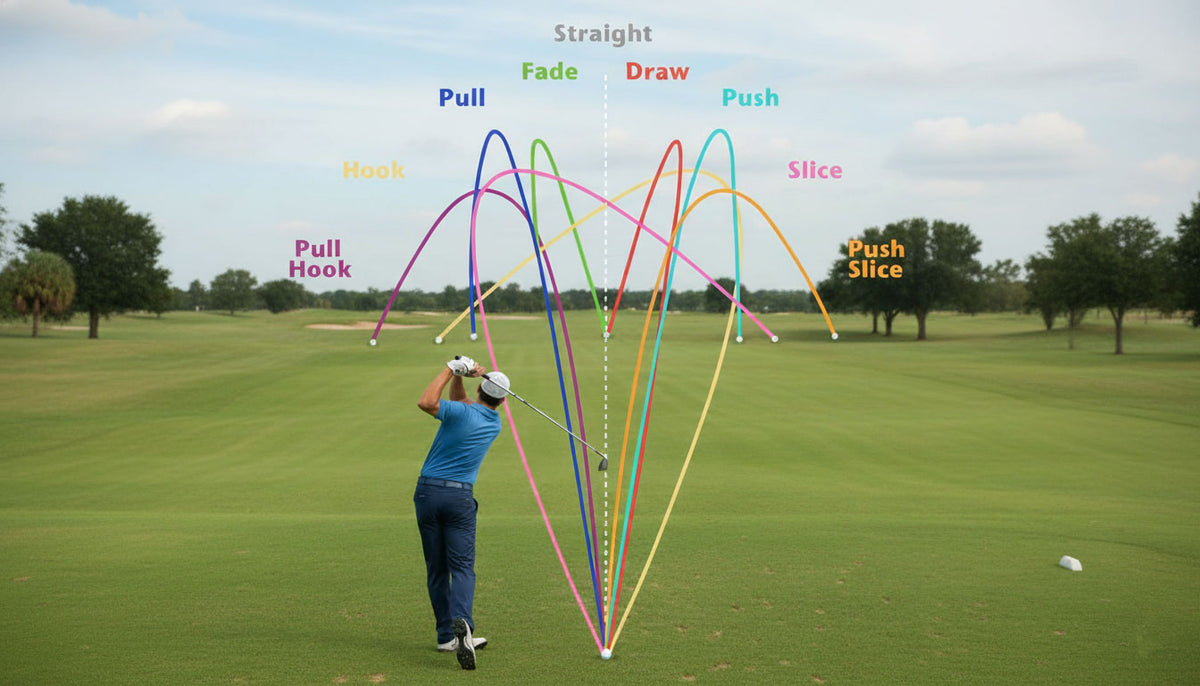
Have a look at this colour-coded image and table to see the 9 ball flights (not including chunks, duffs and that sh*nk of which we will never speak again).

| Club Path | Face open to path | Face square to path | Face closed to path | |||
|---|---|---|---|---|---|---|
| OUT-TO-IN (path left of target) | SLICE (starts left, curves way right) | PULL (starts left, flies straight) | PULL-HOOK (starts left, curves more left) | |||
| NEUTRAL (path near zero) | FADE (starts straight, curves right) | STRAIGHT (starts straight, stays straight) | DRAW (starts straight, curves left) | |||
| IN-TO-OUT (path right of target) | PUSH-SLICE (starts right, curves more right) | PUSH (starts right, flies straight) | HOOK (starts right, curves way left) | |||
| *For right-handed golfers. Row labels describe club path direction; actual start line is still driven mostly by face angle. | ||||||
REMINDER: The clubface angle at impact controls roughly 75–85% of the ball’s starting direction, while club path influences the rest. In general, the longer the club, the more the face dominates start direction.
The curve or spin axis tilt—what makes the ball draw or fade—is caused by the difference between the face angle and the swing path, not the path alone.
And yes, because the ball travels much farther forward than it does sideways, those small differences in face and path can still send the ball well off target!
| Swing Path | Face Angle | Face-to-Path | Start Direction* | Curvature / Spin Axis | Typical Result | Coach Note |
|---|---|---|---|---|---|---|
| +2° in-to-out | –2° closed | –4° closed | 1.2° left | Strong left tilt | Pull-Hook / Hook | Face too closed to path → big left miss risk. |
| +2° in-to-out | +1° open | –1° closed | 1.2° right | Slight left tilt | Stock Draw / Push-Draw ✅ | Safe, controlled draw pattern; starts slightly right and falls back. |
| +2° in-to-out | 0° (square) | –2° closed | 0.4° right | Moderate left tilt | Power Draw ⚡ | More distance/ compression but timing-sensitive (hook risk). |
| 0° neutral | 0° square | 0° | 0.0° | None | Straight (rare) | Hard to repeat; a small, predictable curve is better. |
| –2° out-to-in | –1° closed | +1° open | 1.2° left | Slight right tilt | Stock Fade ✅ | Classic fade pattern; starts slightly left and works back right. |
| –2° out-to-in | +1° open | +3° open | 0.4° right | Moderate right tilt | Push-Fade / Cut | Open face pushes the start line right while the path still cuts across it. |
| –2° out-to-in | +3° open | +5° open | 2.0° right | Strong right tilt | Push-Slice | Face too open to path → right-miss with heavier curvature. |
*Start direction is dominated by the face (about 75–85%) and slightly influenced by path. For right-handed golfers: + = right/open, – = left/closed.
Rule of thumb: Keep your face-to-path difference within 1–3°.
A small, predictable curve beats trying to hit it dead straight. The Stock patterns are your safest defaults; the Power Draw adds distance but increases hook risk.
Why a fade or a draw?
The draw is often treated as the pin-up ball flight in golf, partly because extra yards matter so much at elite level.
In most (good) swings:
- Fade patterns often come with a face that’s slightly open relative to path. That delivery can increase spin loft — the difference between dynamic loft and attack angle — which can increase backspin.
- Draw patterns often come with a slightly closed face relative to path, which can reduce spin loft and therefore backspin.
The result? A draw typically flies a bit lower, penetrates more, and rolls out farther. A fade flies slightly higher, lands softer, and is easier to control.
Both shots have backspin, but their spin-axis tilt and spin magnitude differ — that’s what makes one curve left and the other right.
At the elite level, imagine the precision: a player might know that their fade will fly half a club shorter than their draw — and plan accordingly.
Fade versus draw: spin essentials
| Shot Shape | Backspin? | Spin-Axis Tilt | Typical Spin Trend* | Typical Flight / Roll |
|---|---|---|---|---|
| Draw | Yes — all shots need backspin | Axis tilts left (curves left) | Usually lower spin (less spin-loft) | Flatter flight, more rollout |
| Fade | Yes — backspin keeps the ball aloft | Axis tilts right (curves right) | Usually higher spin (more spin-loft) | Higher flight, softer landing |
| *Trends show common delivery patterns. Distance comes from your personal launch + spin mix, not curve direction. | ||||
Tame your miss
Some people want to change their natural swing, and full points to them. But ask yourself if it's necessary. Will you be a happier golfer by crushing 1 in 4, or missing 1 in 4? Know your swing faults and aim to "tame" them, not eliminate them.
- Aim for 1–3° difference between path and face.
- Let the ball curve gently one way; don’t chase zero.
- Small curves are predictable, perfect “straight” shots are not.
And what about swing plane?
Imagine you’re standing inside a giant hula hoop tilted so it runs through your shoulders and down toward the ball. That hoop represents your swing plane — the flat surface your club travels along throughout the swing.
If the hula hoop is tilted more upright (more vertical), that’s a steeper swing plane — common with shorter clubs. If it’s laid down flatter, that’s a shallower plane — more like your driver.
The goal is to let the club move on a plane that suits its length, lie, and your posture. That’s why you stand closer to the ball with shorter clubs and farther away with longer ones — each club encourages a different setup and general swing plane.
Now imagine rotating that hula hoop left or right. It's not much different to changing your feet alignment, BUT it changes your path in relation to the target!
The direction the hoop is oriented influences swing direction, which then influences club path at impact.
When your swing plane, setup, and delivery work together, it becomes much easier to return the club consistently at impact — that’s when everything just feels right.
Every golf club is designed with a specific lie angle — that’s the angle between the shaft and the sole of the club when it sits perfectly flat on the ground. This lie angle isn’t arbitrary; it influences how the club is meant to sit at address and move through impact.
Shorter clubs (like wedges) generally have more upright lie angles and are often delivered on steeper planes with more downward contact. That usually means standing closer, with a more vertical swing plane.
Longer clubs (like your driver) generally have flatter lie angles and are often delivered on shallower planes. That usually means standing farther away, with a flatter swing plane.
So the built-in geometry of the club strongly influences your ideal swing plane.
You still have to deliver it, but the club gives you a strong starting point. Your job is to match your posture, distance from the ball, and swing motion to the way the club is designed to sit and move through impact.
Swing plane versus swing path: why plane matters
| Term | Plain-English Definition | Why It Matters | Coach Cue |
|---|---|---|---|
| Swing Plane | The tilt or angle of the circle your club travels on — set by posture, setup, and the club’s lie angle. | A consistent plane makes it easier to repeat low point, path, and face delivery. Too flat or too steep can make strike and direction less consistent. | Match your plane to your body tilt; maintain posture to repeat impact geometry. |
| Swing Path | The clubhead’s direction of travel at impact — in-to-out, out-to-in, or neutral — relative to the target line. | Together with face angle, it helps define the ball’s start line and curvature (draw or fade). | Keep face-to-path small (≈ ±1–3°) for a gentle, repeatable curve. |
| The plane influences the geometry; face + path decide start direction and curvature. | |||
Stance and its relationship to the golf swing
Where do you stand to make a golf swing? As covered above, the distance from the ball is largely influenced by the shaft angle and lie of the club you are using.
The width of your feet, and where the ball is between your feet, is a much trickier conversation, but we have some good news, there are ways to simplify it.
The most important aspect of your golf training is consistency. Make sure the ball is in the same place EVERY time with that same club. That is far more important to dial in than going by the textbook.
However, modern coaching methods do have some textbook rules, so here we go. These diagrams are for all full iron shots from PW to 5-iron. Look at where the ball is. Does that look like the "middle of the stance" people talk about? No — and it should not. For full swings, the ball should generally be no farther back than about one clubhead width from the lead heel, including wedges. We open Pandora's Box on that subject here.
From there, only two things really change: 1. as your clubs get longer than a 7-iron, the ball position moves forward, eventually ending up opposite the inside of your lead heel for driver. 2. As the clubs get longer, the stance widens slightly.
Some people prefer the ball a little farther back than others, some a little farther forward.
Another massive misnomer in golf is that the stance width should be "shoulder width". This leaves far too much variation to be useful. Use your hip bone width (which broadly coincides with knees and ankles). The inside of your heels are placed at that width. So your stance is more like a ball width wider on each foot than your knees when standing casually.


